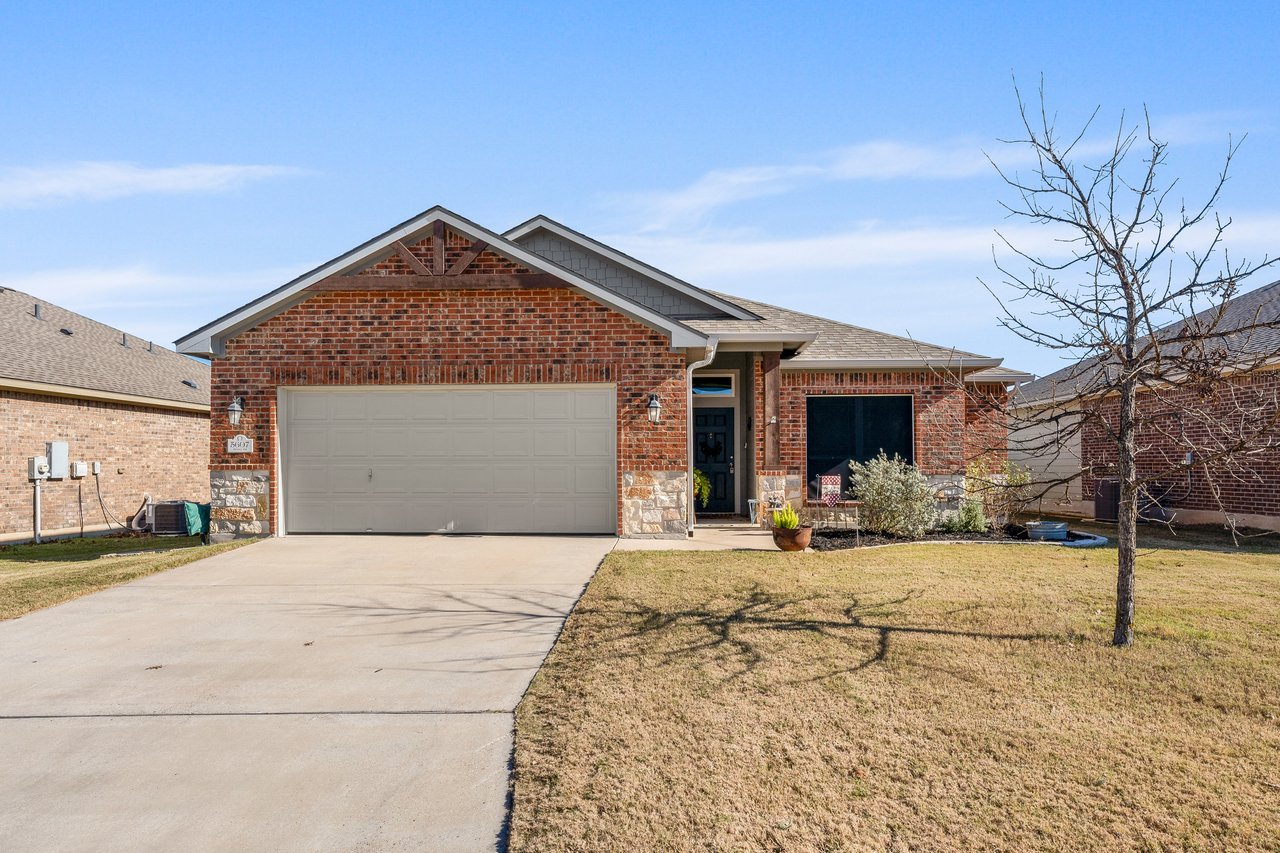
How Much Cash Do You Actually Need to Close on Your First Home in Temple, Texas?
How much cash do you need to buy your first home in Temple, Texas?
For a $300,000 Temple home, a buyer putting 3.5% down might budget roughly $16,500–$25,500 for the down payment and estimated closing costs before credits or assistance. Your actual cash-to-close depends on your loan and property.
You've been browsing homes in Temple or Belton, Texas. You've found a few you love, and you're starting to picture yourself getting the keys.
But then comes the question that stops a lot of first-time homebuyers in their tracks:
How much money do I actually need in my bank account to buy a house?
Maybe you've heard you need 20% down. Maybe a friend told you they bought with almost nothing down. Or maybe you've saved $15,000 and aren't sure whether that's enough to get started.
The truth is that buying your first home involves more than just a down payment—but you may not need as much cash as you think.
At Home in Texas Team, Ali Thompson and McKenna Taggart are a mother-daughter real estate team helping buyers navigate the Temple and Belton housing markets.
If you're preparing to purchase your first home in Bell County, here's how to understand your upfront costs and create a realistic savings goal.
The amount depends on your purchase price, loan program, closing costs, and whether you receive any seller or lender credits.
According to the Consumer Financial Protection Bureau, closing costs typically range from 2% to 5% of the home's purchase price, excluding your down payment.
That means a buyer putting 3.5% down could use approximately 5.5%–8.5% of the purchase price as an initial planning range.
Here's what that looks like for three hypothetical Temple-area purchases.
Home price | 3.5% down payment | Estimated closing costs (2%–5%) | Estimated total |
|---|---|---|---|
$250,000 | $8,750 | $5,000–$12,500 | $13,750–$21,250 |
$300,000 | $10,500 | $6,000–$15,000 | $16,500–$25,500 |
$350,000 | $12,250 | $7,000–$17,500 | $19,250–$29,750 |
These are illustrative planning estimates, not lender quotes. The closing-cost range may include certain prepaid and escrow items depending on the estimate. Do not automatically add those items again. Figures exclude moving expenses, repairs, and reserves and assume no seller credits or assistance.
The biggest takeaway?
You don't necessarily need 20% down to purchase a home.
But you do need to understand all the costs involved—not just the amount you're putting toward the purchase price.
Your down payment is the portion of the purchase price you pay upfront rather than finance through your mortgage.
Different loan programs have different requirements.
Some qualifying conventional loan programs allow down payments as low as 3%.
For a $300,000 home, that's $9,000.
Eligibility depends on the specific loan program, income and other underwriting criteria, credit profile, and lender requirements.
A conventional loan with less than 20% down generally requires private mortgage insurance, although the exact terms vary.
Some eligible borrowers can qualify for an FHA loan with a 3.5% down payment.
For a $300,000 home, that would be $10,500.
FHA loans have mortgage insurance requirements, including an upfront mortgage insurance premium that may be financed when permitted and ongoing premiums.
A 3.5% down payment is not guaranteed for every applicant.
Eligible veterans, active-duty service members, and certain surviving spouses may qualify for VA-backed purchase loans without a required down payment, subject to lender and program requirements.
That doesn't necessarily mean the buyer will have zero closing costs.
A VA funding fee may also apply unless the borrower qualifies for an exemption.
Some eligible buyers purchasing qualifying properties in eligible rural areas may qualify for USDA financing with no required down payment.
Eligibility depends on factors such as household income, property location, occupancy, and loan-program requirements.
Not every property in Temple or Belton will qualify.
The best loan isn't necessarily the one with the lowest down payment. Compare the monthly payment, mortgage insurance, closing costs, interest rate, and total borrowing costs before deciding.
Closing costs are expenses associated with obtaining your mortgage and transferring ownership of the property.
They can include:
Some charges depend on the lender, loan type, title provider, property, and terms negotiated in your contract.
The CFPB's Closing Disclosure guide explains how these charges appear in your final loan paperwork.
For a $300,000 home, a 2%–5% estimate equals $6,000–$15,000.
That's a broad budgeting range, not a prediction of what a particular Temple buyer will pay.
Your lender's Loan Estimate will provide a more personalized starting point.
Texas has two contract-related payments that first-time buyers should understand before making an offer.
Earnest money is a deposit that demonstrates your commitment to purchasing the property.
It is generally held by the escrow agent and credited toward the funds you owe at closing.
For example, if you agree to deposit $3,000 in earnest money on a $300,000 home, that amount generally isn't an additional $3,000 on top of your total purchase costs.
It's money you've paid ahead of closing.
The amount is negotiable, and your contract determines the conditions under which it may be returned or forfeited.
In a typical Texas resale transaction, buyers may negotiate a termination option period in exchange for an agreed option fee.
The option period can provide time to inspect the property and evaluate whether to continue with the purchase.
According to the Texas Real Estate Commission, the termination option is negotiable and is not automatically required in every transaction.
When an option fee is properly paid under the contract and the transaction closes, it is generally credited toward the purchase price.
For example, a buyer might negotiate a $250 option fee, although the actual amount varies.
The important distinction is that earnest money and option fees usually require cash early in the transaction, before the final closing date.
You'll want those funds available when you begin making offers.
This is one of the most overlooked parts of first-time homebuyer budgeting.
When you purchase a home with a mortgage, your lender may require you to prepay certain expenses and establish an escrow account.
That account helps pay future property tax and insurance bills.
Many lenders require proof of homeowners insurance before funding the loan.
You may need to pay the first year's premium in advance, depending on the insurance and closing arrangements.
The cost varies based on the home, coverage, deductible, and insurer.
A larger or older property may have different insurance costs than a newer home of similar price.
Your lender may also collect an initial amount toward future property taxes.
For homes in Temple and Belton, property taxes can involve several taxing entities, including the city when applicable, Bell County, the relevant school district, and other applicable districts.
The amount depends on the property's taxable value, location, exemptions, and adopted tax rates.
If you're buying in the fall, timing matters because Texas property tax bills are generally issued around October and typically become delinquent if not paid by February 1 of the following year.
Your closing statement may also reflect property tax prorations between you and the seller.
For example, a seller may be responsible for an agreed allocation of taxes attributable to the period they owned the home, with the settlement handled through closing adjustments.
A seller's tax proration is not necessarily the same thing as cash available to pay your closing costs. The actual accounting depends on the contract and settlement statement.
Also, don't assume the previous owner's property tax bill will be identical to yours.
If the seller had a homestead exemption or another exemption that doesn't apply to you, your future taxes may differ.
Before making an offer, ask for a property-specific estimate of your future taxes rather than relying solely on the seller's current bill.
Let's walk through a hypothetical first-time buyer example.
Assume you're purchasing a $300,000 home with a 3.5% down payment.
Item | Example amount |
|---|---|
Purchase price | $300,000 |
Down payment (3.5%) | $10,500 |
Estimated closing costs, including assumed prepaids and escrow | $9,000 |
Total upfront purchase costs | $19,500 |
Earnest money already deposited | -$3,000 |
Option fee already paid and credited | -$250 |
Estimated remaining cash due at closing | $16,250 |
This example assumes the $9,000 closing-cost figure includes applicable prepaids and initial escrow deposits, and that the $250 option fee is credited at closing. It assumes no seller credits, lender credits, assistance, or other adjustments. The final settlement statement may differ.
Notice the distinction:
Your total estimated upfront purchase costs are $19,500.
But if you've already paid $3,250 in credited deposits, the remaining amount due at closing could be $16,250.
That doesn't mean the home costs less.
It means part of your required funds was paid earlier in the transaction.
This is why it's so important to distinguish total cash needed for the purchase from cash still due on closing day.
With the right realtor helping you negotiate - potentially, yes. Markets dictate what mot sellers are willing to contribute towards buyers closing costs.
Depending on the purchase contract and financing requirements, a seller may agree to contribute toward allowable closing costs.
These are often called seller concessions or seller-paid closing costs.
Let's return to the $300,000 example.
If your estimated closing costs are $9,000 and the seller agrees to contribute $5,000 toward eligible expenses, your out-of-pocket costs could decrease.
Item | Example amount |
|---|---|
Down payment | $10,500 |
Estimated closing costs | $9,000 |
Seller contribution toward eligible costs | -$5,000 |
Total estimated upfront purchase costs | $14,500 |
Previously paid earnest money and credited option fee | -$3,250 |
Estimated remaining cash due at closing | $11,250 |
This is a hypothetical illustration, not a representation of current seller offers.
Seller contributions have program-specific limits and generally cannot be used to satisfy the buyer's required down payment.
Your lender must confirm that the proposed contribution is permitted.
Also, the seller may consider the requested contribution when evaluating your offer.
A seller contribution is part of the overall negotiation—not free money with no impact on the transaction.
Yes. Texas has programs designed to help eligible homebuyers with down payments and, in some cases, closing costs.
Two useful places to begin your research are:
Texas State Affordable Housing Corporation (TSAHC): Visit TSAHC to explore its homebuyer programs and participating lenders.
Texas Department of Housing and Community Affairs (TDHCA): Visit TDHCA for information about state homeownership assistance options.
Availability, eligibility, assistance amounts, repayment obligations, and program rules can change.
Some programs provide assistance through grants, while others may involve second liens or other repayment conditions.
Don't assume a program is free money or that every first-time buyer qualifies.
A participating lender can help you compare the total cost of a mortgage with assistance against one without assistance.
Mortgage rates influence your monthly payment and how much home you may qualify to purchase.
According to Freddie Mac's October 15, 2026 survey, the national average 30-year fixed mortgage rate was 7.40%.
That figure reflects a particular survey population, including conventional borrowers with strong credit and substantial down payments. It is not a guaranteed rate for a first-time buyer putting 3% or 3.5% down.
For a $300,000 purchase with a 3.5% down payment, the base loan amount would be $289,500.
At a hypothetical 7.40% fixed rate over 30 years, principal and interest would be approximately $2,004 per month.
That excludes property taxes, homeowners insurance, mortgage insurance, HOA dues, and other costs.
Your actual rate and payment will depend on your lender's quote and loan terms.
While rates affect affordability, they don't tell you how much cash you'll need to close.
That's why buyers should review both their estimated monthly payment and their cash-to-close amount.
One of the most important things you can do as a first-time buyer is avoid using every dollar of your savings to purchase the house.
Even a well-maintained home can come with unexpected expenses.
You may need money for moving, utility deposits, furnishings, lawn equipment, minor repairs, or emergency maintenance.
The Consumer Financial Protection Bureau recommends setting aside funds for initial homeownership expenses rather than allocating all available cash to the down payment.
How much you should keep in reserve depends on your income stability, monthly obligations, property condition, and personal comfort level.
The goal isn't simply to qualify for a mortgage.
It's to feel financially prepared after you receive the keys.
Buying your first home involves several moving parts.
You'll need to understand your budget, loan options, available homes, contract terms, inspections, and closing expenses.
At Home in Texas Team, Ali Thompson and McKenna Taggart help first-time buyers navigate the process in Temple, Belton, and surrounding Bell County communities.
As a mother-daughter-run real estate team, we believe you should understand what you're agreeing to and how each decision affects your purchase.
That includes helping you evaluate properties within your budget, understand contract timelines, and coordinate with your lender and title company.
A lender determines your mortgage eligibility and financing terms, while your real estate team helps you understand the homebuying process and negotiate the purchase.
Together, those roles can help you make informed decisions.
No. Some qualifying conventional loans allow down payments as low as 3%, FHA loans may allow 3.5%, and eligible VA or USDA borrowers may qualify for no-down-payment financing. Each program has its own requirements and costs.
Possibly. It depends on the home's price, your financing, closing costs, and whether you qualify for assistance or seller contributions. A lender can help determine whether your available savings are sufficient for a particular purchase.
Earnest money is generally credited toward the total funds required at closing. It is not usually an additional expense on top of the purchase price and closing costs. The actual credit and refund conditions depend on your contract.
You don't need to have every answer before beginning your home search.
But understanding your cash-to-close estimate is one of the smartest places to start.
Whether you've saved $10,000, $20,000, or more, the next step is learning what that amount could realistically support based on your financing and the homes available in your price range.
Home in Texas Team can help you understand the buying process, explore Temple and Belton homes, and connect the pieces of your purchase plan with your lender.
We're Ali Thompson and McKenna Taggart, the mother-daughter real estate team behind Home in Texas Team, serving Temple, Belton, and surrounding Central Texas communities.
Thinking about buying your first home? Contact Home in Texas Team to discuss your budget, your goals, and the steps toward purchasing a home in Temple or Belton, Texas.
Ali Thompson & McKenna Taggart | Home in Texas Team | First-Time Homebuyer Resources in Temple & Belton, Texas
This article is for general educational purposes and is not a mortgage quote, lending commitment, or legal or tax advice. Costs, rates, program eligibility, and assistance availability vary.
A First-Time Buyer's Guide to Down Payments, Closing Costs, Earnest Money, and the Cash You'll Actually Need in 2026
A Relocation Guide to Buying Before Selling, Bridge Loans, Contingent Offers, and Coordinating Closings Across State Lines
A Move-Up Buyer's Guide to Coordinating Two Closings, Using Your Home Equity, and Avoiding a Double Move
January vs. Spring 2027: Comparing Buyer Demand, Competition, and Market Conditions to Help Temple and Belton Luxury Homeowners Decide When to Sell

Why November and December Could Give Temple and Belton Homebuyers More Negotiating Power in 2026

What relocating homebuyers should know about Central Texas school ratings, campus differences, and choosing where to buy.
Leaving Fort Hood? Discover Whether Selling or Renting Your Killeen Home Makes Sense—and Why Temple, Belton, or Salado Could Be Your Next Move.
How Seller Concessions, Rate Buydowns, ARMs, and Builder Incentives Can Help You Buy in Today’s Market

What Temple, Belton & Salado Homebuyers Need to Know Before Buying Acreage or Luxury Property
Through my business, my involvement in our community, and my dedication to my clients, I have developed a great network of friends and business associates. If you need something, I’ll be able to help….and that’s what I love doing!

Ali L. Thompson
McKenna Taggart
Address
6270 W ADAMS AVE
TEMPLE TX 76502